
Probiotics – Not just for healthy people!

An article by Top Country Animal nutritionist, Katie Fairfax
PROBIOTICS - NOT JUST FOR HEALTHY PEOPLE!
Probiotics are usually associated with human health and wellbeing however recent research, trials and producer feedback has led to an increasing number of livestock producers incorporating probiotics in their feeding regime to improve production… with very positive results!
How does it work?
The inclusion of a probiotic such as Bovacillus or Levucell into Top Country’s custom dry licks and grain rations aims to bolster the rumen with positive fibre digesting bacteria (i.e. Bacillus subtilis/Bacillus licheniformis and Saccharomyces cerevisiae).
Within the rumen, large microbes called Protozoa are responsible for the breakdown of sugars and starches (such as grain and molasses) however they release lactic acid as a by-product. Lactic Acid in excess can lower the pH of the rumen and depress or kill fibre consuming microbes. This in turn can lead to acidosis and in extreme cases, death of the animal.
A healthy rumen contains sufficient fibre digesting bacteria to maintain a stable pH of 5.8-7. At this neutral level, the animal can convert feed stuffs into nutrients such as energy (Volatile Fatty Acids), protein (amino acids and true ‘microbial’ protein) and fat. Optimising feed intake and nutrient digestion ultimately translates to production gains in key areas such as milk quality, fertility, muscle and fat laid down and/or semen production.
How do Probiotics help protect against disease?
Ruminant stock being introduced to a diet high in sugars and starches can often experience a spike in lactic acid production which causes the pH of the rumen to drop below 5.8. Not only does this reduce the number of good bacteria in the rumen, it also allows dangerous pathogens such as Clostridium perfringens and E. Coli to proliferate. This can significantly increase the stress on animals which are already compromised (i.e. freshly transported, weaned or physiologically struggling from drought or adverse weather). Probiotics have been found to reduce pathogens by up to 69% by attaching to the mucus lining of the rumen – preventing the pathogens from leaking out of the stomach and infect the blood stream (see figure 1 below) (Cappellozza, B.I. et al. 2023).
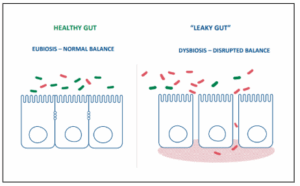
Figure 1: Shows the difference in permeability between a healthy gut and one which is damaged by the presence of bad bacteria. Leaky gut can increase infection rates in animals under physiological stress – decreasing productivity and inducing weight loss. (Cappellozza, B.I. et al. (2023)).
So, what does this mean for producers?
Ultimately, bacteria in the rumen influence the speed at which fibrous feed (i.e. hay, dry feed, fibre pellets) can be digested and converted to energy, protein or fat.
For producers who are looking to push daily weight gain (i.e. for finishing steers, or spike feeding bulls or first calf heifers) or simply carry breeders through dry periods – probiotics can help to achieve these production goals. Research suggests a potential for daily weight gain between 50-80g/head/day, with the inclusion of a probiotic, in addition to an animal’s average daily gains.
For producers wishing to start animals on a grain-based ration or a forage crop, high in sugar and starch, a probiotic can help safeguard against the effects of acidosis and reduce production losses as animals (and their rumen microbe populations) adjust to the different feed.
For producers who sell into EU (European Union) markets, the use of antibiotic ionophores such as Monensin (also known as Rumensin) is prohibited. As such, the use of a probiotic can be a viable alternative for EU producers wishing to improve production for sheep/cattle on grain rations, increase feed intake on pastures or stop using antibiotics altogether.
Monensin and Bovacillus can be used in combination to increase rumen efficiency, fibre intake and production gains. Monensin actively decreases the number of acid producing protozoa in the rumen and the probiotic fills this gap with high numbers of fibre digesting bacteria. Top Country has seen promising results in feed intake and weight gain by combining a probiotic with Monensin in both dry lick and grain ration products.
Ultimately the inclusion of a probiotic into your Top Country dry lick or grain ration can help improve feed digestion by stimulating preferred microbial growth and a stable pH to reduce the risk of metabolic disorders such as acidosis, milk fever, ketosis and grass tetany. Probiotics can help strengthen immunity by decreasing the permeability of the rumen lining which decreasing pathogens leaking into the bloodstream and are an ideal substitute for antibiotic ionophore rumen modifiers such as Monensin, which are banned from EU markets.
If you’d like to know more about how Top Country incorporate probiotics into our Dry Lick and Grain rations, give one of our friendly nutritionists a call between Monday to Friday on (07) 4622 8330.
Cappellozza, B.I. et al. (2023) Evaluation of a bacillus-based direct-fed microbial probiotic on in vitro rumen gas production and nutrient digestibility of different feedstuffs and total mixed rations, Translational animal science. Available at: https://pmc.ncbi.nlm.nih.gov/articles/PMC10199785/#_ci93_ (Accessed: 22 August 2025).
