
Advantages of Early Weaning

The 2023/24 summer season has started strong, with widespread storms and rainfall across parts of QLD and NSW, bringing relief to many after months of dry conditions. Fresh pasture has flourished with the warm weather, and livestock are picking up again. With such conditions, typically considered drought strategies such as early weaning and confinement feeding may seem like a distant memory.
As good as the green pasture is, it can be deceiving. High rainfall, combined with overcast days, decreases the level of dry matter (DM) in the pasture, hinders photosynthesis and allows for the leaching of sugars in the plant. This means that although the pasture may look great and, on a DM basis, has high levels of energy and protein, the high moisture dilutes this, leaving livestock unable to reach their daily dry matter intake and falling short of their daily nutrient requirements. Similar to what is seen during dry conditions, breeder body condition can deteriorate as they attempt to support their young.
In these situations, early weaning can prove as beneficial as it does during drought-like conditions.
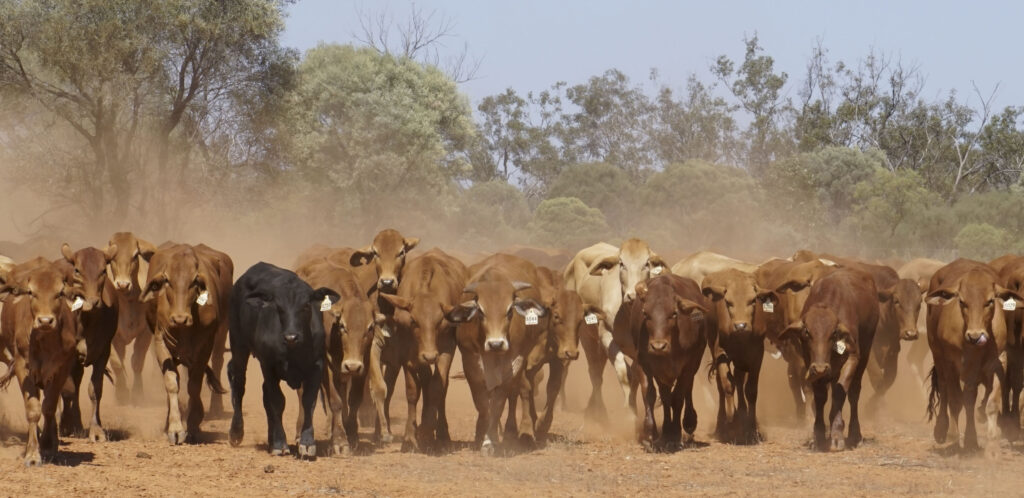
What is Early Weaning?
Early weaning refers to the weight range of which young stock are removed from their mothers. In cattle, early weaned calves are 100-150kg; in small ruminants such as lambs and kids, it is 10-15kg.
Early weaning can be broken down into two main benefits, first for the breeder, and second for the weaners.
Breeder Benefits
The main benefit for the breeder is that you are looking after your ‘calf-factory’, which aside from pasture, is possibly the single most valuable asset to the breeding business.
For beef producers, a common aim is to get one calf per year from each breeder. With a 280-day gestation period, this leaves only an 85-day window to get her back in calf. Bos Indicus breeds, such as Brahman, are notoriously difficult to achieve these rebreed rates in. Research has demonstrated that Bos Indicus cattle do have a higher incidence of lactational anoestrus, meaning they do not cycle during lactation. Weaning these calves earlier gives them a better chance of cycling again.
During late gestation and going into peak lactation, the energy and protein requirements of the animal double and triple respectively, compared to her maintenance requirements.
Often, these peak requirements occur when pastures are at their lowest quality, and protein and energy are the most limiting. However, this can also occur in very moisture-heavy pastures. This means to support her young, the breeder funnels everything into it and will begin dropping in condition. Whilst some loss of condition is expected during this time, the magic body condition score (BCS) number is 2.5.
Once a breeder falls below a BCS of 2.5, her ovaries can become dormant, leading to a prolonged anoestrus, and potentially missing the window to re-conceive. Even if she does manage to conceive, she is fighting an uphill battle to regain her lost condition, and it can become a very tough cycle to break on pasture and low-intake supplements alone.
By ensuring weaning occurs before the breeder falls below a BCS of 2.5, she will have a greater ability to regain her condition with minimal supplementary feeding, and increases the expected re-breed rates from below 50% towards 70-85%.
Below is a table from the MLA, showing how the pregnancy rate of a typical crossbred lactating breeder cow increases as condition increases.
| Liveweight/BCS | Expected Pregnancy Rate % (for following year) | |
| 300kg | Poor (1) | 0 – 40 |
| 330kg | Backward store (2) | 20 – 50 |
| 360kg | Store (3) | 40 – 80 |
| 390kg | Forward Store (4) | 60 – 90 |
| 420kg | Prime (5) | 80 – 95 |
Meat & Livestock Australia Limited, ‘Managing the breeder herd – Practical steps to breeding livestock in northern Australia’, 2006
Weaner Benefits
When done correctly, an early weaned calf, lamb or kid, gets a kick-start to life, and sets them up to continue going forward when they need it the most. There is no substitute for colostrum and milk during early life, as they are rich in nutrients and provide the offspring with passive immunity against a range of diseases. However, as they transition from pre-ruminant to ruminant, and their digestive system adapts to handling a more fibrous diet, they become very efficient feed converters.
Calves may only be able to consume 1.5 – 2.5kg DM daily, but with the right feed, they can convert this to 1kg of growth daily.
As a minimum, beef weaners should be gaining 0.2kg per head per day. Optimal growth rates are between 0.7kg – 1.1kg daily. Supplying a minerally balanced, highly digestible and palatable ration, which is high in protein and energy, the animal can rapidly build bone and muscle, and establish their rumen and digestive health. Even a minor set-back during this time can have life-long implications for that animal.
Although encouraging compensatory growth in weaners is a popular practice to turn stock off quicker, research has demonstrated that cattle under 150kg liveweight have very little ability to compensate, and even larger weaners up to 300kg liveweight exhibit varied responses. Due to a lack of fat around the gastrointestinal tract of nutritionally deprived stock, they are physically able to consume more DM. This means that although their gains may look good on paper, it would have been more economically sound to feed them when they were smaller, and utilising their feed better.
By achieving faster growth rates through supplemental feeding, the time taken to reach certain milestones decreases. Replacement females can meet their critical mating weights (CMW) earlier, allowing them to begin producing calves sooner. Similarly, in backgrounding and fattening operations, a higher stock turnover can be achieved by reaching the target weight sooner. Research has also shown that early weaned stock are better acclimated to a feedlot environment, reducing their level of stress and time spent as a shy feeder.
Producer Benefits
Early weaning has proven beneficial to both the mother and the offspring, which, in turn, significantly benefits the producer. During periods of dry, early weaning also aids in alleviating both pasture and water pressure. It also reduces feed costs as young stock are cheaper to feed in comparison to feeding the breeder to support herself and the young.
For a dry pasture situation, consider the below economics.
A 550kg beast can eat above 11kg of dry matter daily, and with a 4-month calf at foot, needs over a kilo of straight protein, and 150Mj of metabolisable energy (ME) daily. Assuming a low-quality pasture contains 7Mj/kg ME, 5% Protein, and has a 70% Neutral Detergent Fibre (NDF), she can only physically eat 9.4kg of pasture a day, giving her only 65Mj of energy, and 470g of protein daily. Obviously, this falls well under what she requires, and leads to an inevitable loss in condition.
If a complete ration were to be fed, containing 11Mj/kg ME and 14% protein, this same animal could consume 13.75kg DM, supplying 1.9kg of protein and 150Mj ME. This would support both her and her calf. As complete rations have a lower DM content, a complete feed would be closer to a 16kg intake on an as fed basis, and at roughly $800 + GST per tonne, this would cost $12.80 per head per day to feed.
Evaluating the above two situations, if the cow had her calf removed through early weaning, in the pasture scenario, she would maintain condition, and on a full feed ration, she would start gaining weight.
Compare these figures to what it would cost to feed a 120kg early weaned calf. On a complete ration, they could consume up to 2.5% of their bodyweight DM, totaling 3.5kg daily on an as-fed basis. With a rough cost of $950 + GST per tonne, it would cost $3.33 per head per day to feed. At 18% protein and 12.5Mj/kg ME, the expected gains for this weaner are 0.75kg – 1.5kg daily. Even at the lower gains, it would cost $4.44 to gain a kilo of liveweight.
Based off these economics, there is a clear economic benefit to producers when it comes to early weaning.
With so many benefits to early weaning, why not talk to our friendly staff about our range of early weaning supplements for cattle, sheep and goats. Contact us on (07) 4622 8330 or enquire here and speak to one of our sales nutritionists today.
Disclaimer: All animal stockfeed should be fed as part of a nutritious, balanced diet to match the livestock’s specific requirements. Ensure that animals always have plenty of fresh, clean water available for drinking. Top Country makes no representations or warranties of any kind, express or implied, as to the suitability of any of the products supplied to the specific requirements of your livestock. It is recommended that you consult your ruminant nutritionist before making any major dietary changes.