
Supplementing on Mulga
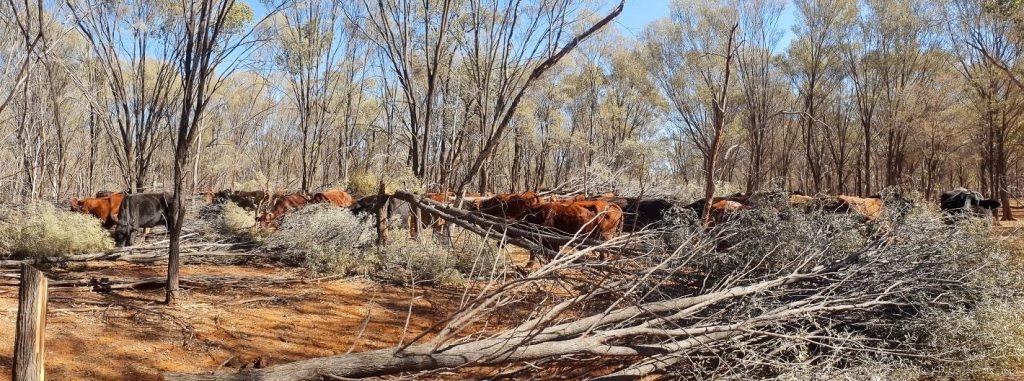
Edible scrub is a precious resource that can be used as an alternative feed source for livestock. Many native trees and shrubs can provide enough energy to maintain most classes of stock when supplemented with a suitable protein source. Mulga (acacia aneura) is widely distributed throughout inland Australia, where it offers valuable fodder for both sheep and cattle, particularly during drought. Branches and selected trees are usually trimmed or pushed to allow stock access to leaves above browse height.
Mulga can regenerate from seed, and this usually takes place on bare ground. However, it can take several years and requires careful grazing management for up to five years. As droughts can be frequent, careful monitoring of harvested areas is required to ensure they are fully recovered before further harvesting takes place. Good quality water should always be available while feeding mulga. If troughs are used for stock water, ensure they are cleaned out regularly.
Mulga contains tannins, a biomolecule that contains anti-nutritional effects on animals because of its protein-binding properties and effect on depression in food intake. This binding behaviour prevents the animal from accessing the protein while grazing mulga, which means ruminants cannot break down the total amount of protein provided in the feed, resulting in low animal production. Mulga is also deficient in phosphorus and sulphur. Supplying adequate quantities of mulga is crucial to allow livestock to select leaf rather than coarse stems and branches, which are low in quality and difficult to digest.
The Top Country dry lick range can easily address these deficiencies by using one of our supplements with a high level of protein, phosphorus and sulphur to assist with the breakdown of tannins and improve digestion efficiency. Adding extra sulphur into the dry lick assists the cattle in breaking down the tannins in the mulga leaves and can also increase dry matter intake significantly, resulting in a higher live weight.
In summary, livestock fed on mulga need supplementation with protein, phosphorus and sulphur to increase intake to a level adequate for maintaining live weight in cattle and sheep. The Top Country dry lick range also provides a balance of minerals, ensuring that the maximum levels are absorbed and used for maintenance, milk production, fertility and growth, and to prevent any deficiencies that may occur during dry times.
Top Country’s dry lick supplements aim to correct the mulga feed’s minerals and protein content deficiencies and fast the passage rate through the rumen. Top Country will custom-make your supplements to meet the needs of your land, stock, season and favourite outcomes. If you would like to learn more about Top Country mulga supplements range, please get in touch with Top Country and speak to one of our qualified nutritionists today!
— Tamara Freitas, Nutritionist

References
- Bhat, T.K., Kannan, A., Singh, B. et al. (2013). Value Addition of Feed and Fodder by Alleviating the Antinutritional Effects of Tannins. Agric Res 2, 189–206 https://doi.org/10.1007/s40003-013-0066-6
- Brown, J. (2021). Sheep and Cattle on Mulga [Photographs]. Queensland, Australia.
- Casburn, G. (2016). Using mulga as a forage supplement for livestock in droughts. NSW Department of Primary Industries. https://www.dpi.nsw.gov.au/__data/assets/pdf_file/0003/671421/using-mulga-as-a-forage-supplement-for-livestock-in-droughts.pdf
- Gartner, R.J.W. and Niven, D.R. (1978). Studies on the supplementary feeding of sheep consuming Mulga (Acacia aneura). CSIRO Publishing. https://www.publish.csiro.au/an/ea9780768
- Hoey, Norton et al. (n.d.). A Preliminary Investigations Into Molasses and Sulphur Supplemenation of Shep Fed Mulga. Livestock Library. http://livestocklibrary.com.au/bitstream/handle/1234/6833/Hoey76.PDF?sequence=1